Petrova line
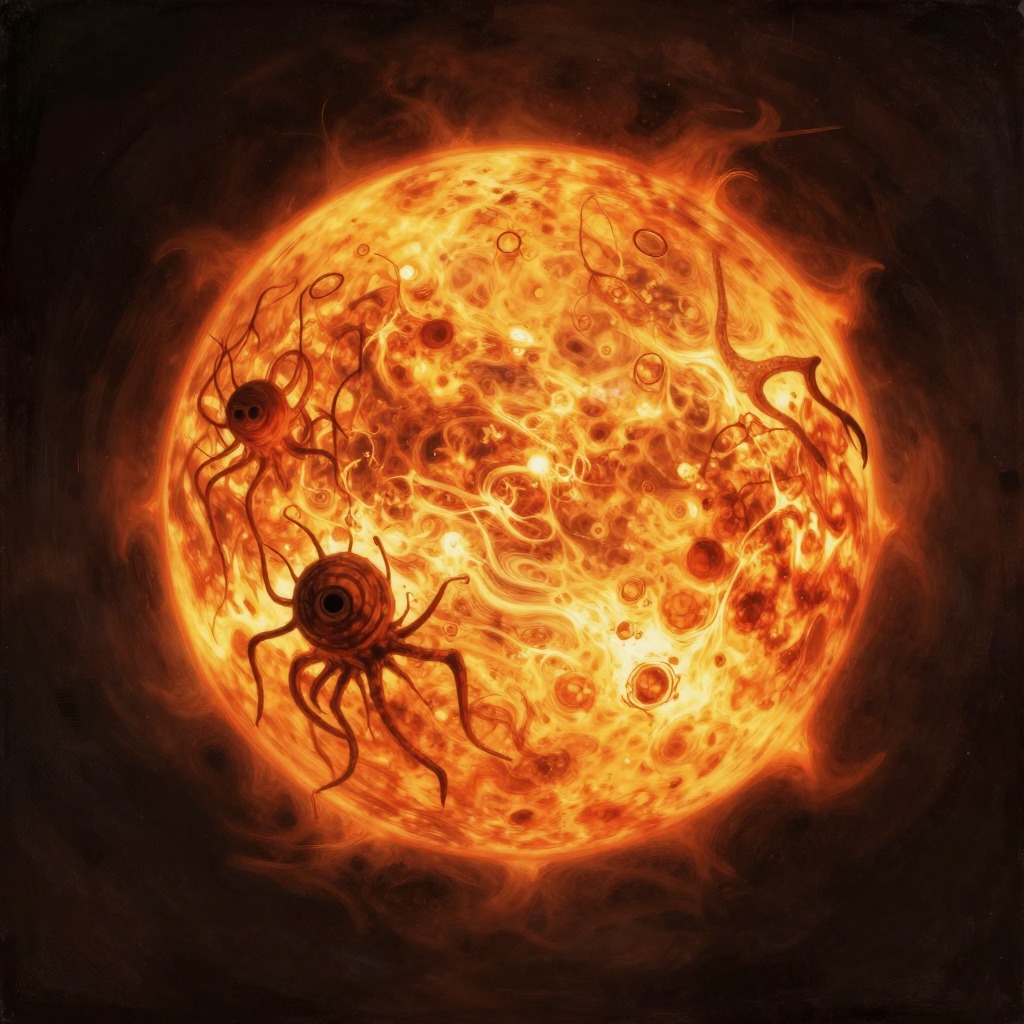
The Petrova line is the infrared signature of an alien ecological catastrophe. Discovered by Russian astronomer Dr. Irina Petrova, this faint, monochromatic emission at 25.984 microns traces the migration route of Astrophage—a star-eating microbe—from the Sun's north pole to Venus. Its detection sets in motion the chain of events that leads to the Hail Mary mission, making it the single most important astronomical discovery in the novel's world.
Discovery and Initial Observations
Dr. Irina Petrova, working at the Pulkovo Observatory in St. Petersburg, Russia, first detected the line while studying infrared emissions from nebulae. Using extremely sensitive detection equipment, she found a very faint but detectable line in the solar system emitting infrared light solely at the 25.984 micron wavelength, with no variance. The line forms a lopsided arc that rises straight up from the Sun's north pole for 37 million kilometers, then angles sharply down and away from the Sun toward Venus. At Venus, the arc's cross-section is as wide as the planet itself. Petrova's findings were confirmed by the Atacama observatory in Chile, widely considered the best IR observatory in the world. She initially speculated that the emission could be from space dust, particles moving along magnetic field lines, or a molecular compound absorbing and re-emitting energy. However, the shape of the arc puzzled her, as Venus has no magnetic field to speak of—no magnetosphere, no ionosphere—making it unclear what forces would make particles arc toward it and glow.
Connection to the Solar Crisis
The Petrova line's true significance emerges when Japanese space agency JAXA's solar probe Amaterasu correlates it with the Sun's dimming. JAXA data shows the Sun's output is decreasing at an exponential rate, and the Petrova line is getting brighter at the same rate. As Ryland Grace learns from his friend Marissa, the line is somehow stealing energy from the Sun. The exponential progression of solar dimming is consistent with the exponential population growth of a typical life-form. This realization transforms the Petrova line from a curious astronomical anomaly into the visible signature of an existential threat: Astrophage, an alien microbe that consumes solar energy and uses it for propulsion, leaving the Petrova-frequency light as its exhaust.
Astrophage Migration and the Life Cycle
Grace's later experiments in his San Francisco lab reveal that the Petrova line is the direct result of Astrophage's breeding migration. Astrophage cells, after gathering energy on the Sun's surface, follow magnetic field lines straight away from the Sun's north pole—a necessary detour to avoid the Sun's blinding light and gain a full view of Venus's orbital path. Once oriented, they detect Venus's massive carbon dioxide spectral signature at 4.26 and 18.31 microns and fly directly toward it. The path they take—straight away from the solar pole, then sharply turning toward Venus—is the Petrova line. At Venus's upper atmosphere, they collect the carbon dioxide needed to reproduce, then both parent and daughter cells return to the Sun to begin the cycle anew. The infrared light they emit for propulsion, at the 25.984 micron wavelength, is what makes the Petrova line visible across interplanetary space.
Narrative and Thematic Significance
The Petrova line serves as the novel's central mystery and the catalyst for the entire plot. It is the first evidence that something unnatural is happening to the Sun, and its discovery by Petrova, followed by JAXA's confirmation of its link to solar dimming, forces humanity to confront an unprecedented threat. The line's name becomes a shorthand for the Astrophage crisis—Grace refers to "the Petrova problem" throughout the story. The line also provides the key to understanding Astrophage's biology and behavior, enabling Grace to deduce the microbe's life cycle and ultimately to breed it for fuel and to find its predator, Taumoeba. Thematically, the Petrova line represents the hidden interconnectedness of cosmic phenomena: a faint infrared glow, barely detectable by the most sensitive instruments, turns out to be the exhaust trail of an alien species that threatens to extinguish all life on Earth.